
Course Player
Falls, Mobility, Transfers & Injury Prevention
Topic
Lesson 1.1 — Understanding Falls in Long-Term Care
Introduction: Why Falls Matter So Much
Falls are one of the most common and most serious safety problems in long-term care. A single fall can change a resident’s life. A hip fracture can end the ability to walk. A head injury can cause bleeding inside the skull. Even a fall with no injury can leave a resident afraid to move, which leads to weakness and more falls.
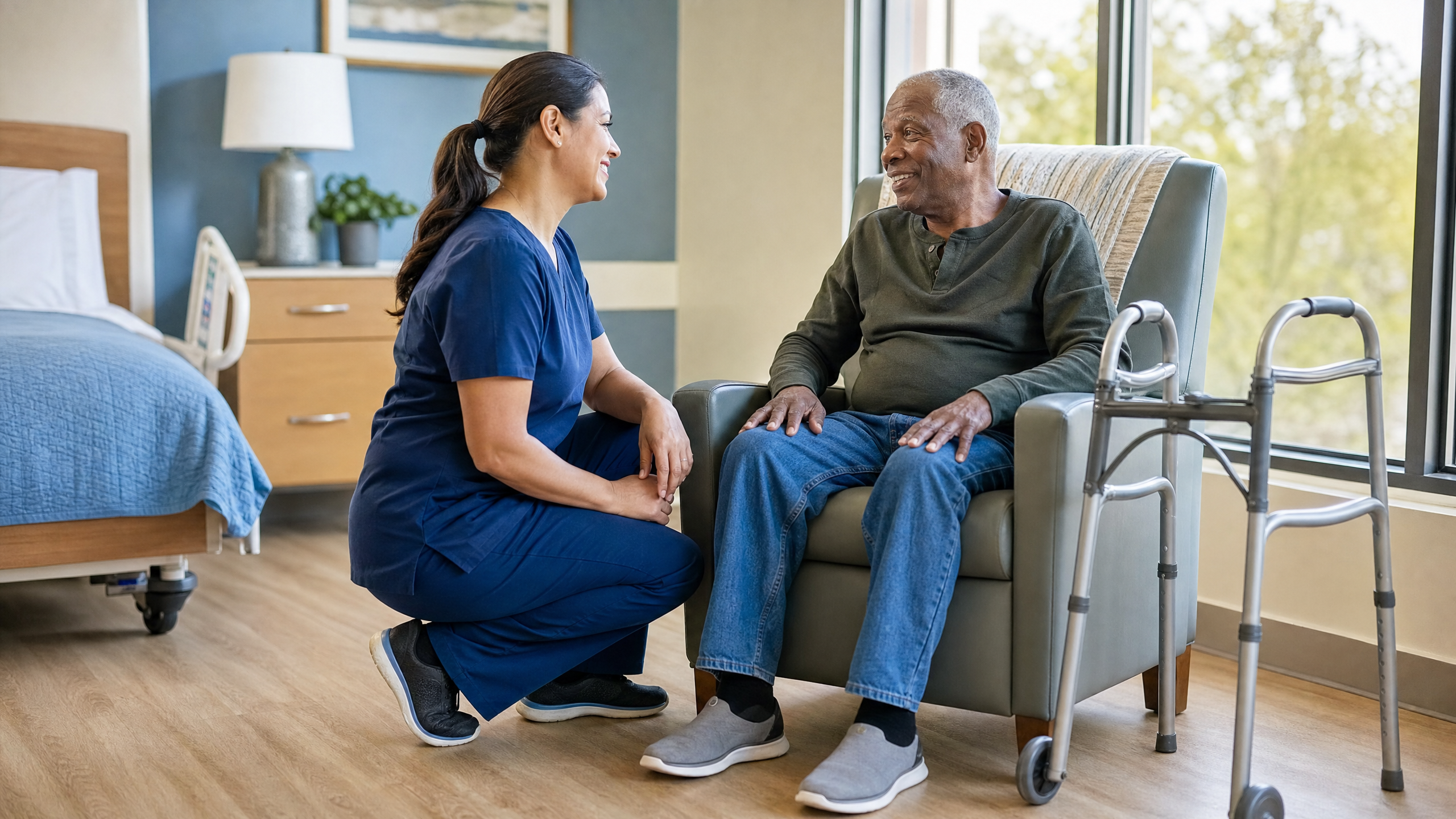
CNAs spend more time with residents than anyone else on the care team. You help residents stand, walk, toilet, and move many times each shift. That makes you one of the most important people in preventing falls — and in noticing when a resident’s fall risk is changing.
Learning Objectives — By the end of this lesson, you will be able to:
- Define a fall using the definition used in nursing homes.
- Describe how often falls happen and why they are serious for older adults.
- Explain the difference between intrinsic and extrinsic fall causes.
- Describe the CNA’s role in fall prevention within CNA scope.
What Counts as a Fall
CMS defines a fall for nursing home assessments as an unintentional change in position coming to rest on the ground, floor, or onto the next lower surface (for example, onto a bed, chair, or bedside mat) [FEDERAL — CMS RAI Manual, Section J]. Key points:
- A fall can be witnessed, reported by the resident or someone else, or discovered when a resident is found on the floor.
- An intercepted fall — when a staff member or the resident stops the fall partway — still counts as a fall. If you "catch" a resident or ease them to the floor, it is still a fall and must be reported.
- A loss of balance during supervised therapy that ends on the floor is still a fall.
- CMS revised the MDS fall definition effective October 2025. Some sources now say a fall caused by an overwhelming external force (such as one resident pushing another) is counted as a fall for MDS coding, while older survey guidance excluded it [FEDERAL — CMS RAI Manual, Section J (Oct. 2025); REQUIRES RN/REGULATORY VERIFICATION of current wording].
Why the definition matters to you: Residents and staff sometimes say, "She didn’t really fall — she just slid down." If the resident unintentionally ended up on a lower surface, report it as a fall. Licensed staff decide how it is coded.
How Common and How Serious
- In the United States, over 14 million adults age 65 and older — about 1 in 4 — report falling each year, and falls are the leading cause of injury and injury death in this age group [EVIDENCE — CDC].
- In nursing homes, earlier CDC data found that half to three-quarters of residents fall each year, about twice the rate of older adults living in the community, and that 10% to 20% of nursing home falls cause serious injuries and 2% to 6% cause fractures [EVIDENCE — CDC fact sheet citing Rubenstein and others; older data].
- AHRQ notes that about half of nursing facility residents fall each year, and about 1 in 3 who fall will fall two or more times [EVIDENCE — AHRQ Falls Management Program].
- CDC has reported that about 35% of fall injuries in nursing homes occur among residents who cannot walk — showing that wheelchair users and bed-bound residents also fall, often during transfers [EVIDENCE — CDC].
Outcomes of falls include fractures (especially hip and wrist), head injuries, skin tears and bruises, pain, loss of independence, fear of falling, depression, hospital transfer, and death.
Why Falls Happen: Intrinsic and Extrinsic Causes
Falls in nursing homes usually result from a combination of risk factors, not just one [EVIDENCE — AHRQ].
- Intrinsic factors are inside the resident: muscle weakness, balance or gait problems, dizziness, low blood pressure when standing, vision or hearing loss, dementia or delirium, foot pain, urgent bladder needs, certain medications, and acute illness such as an infection.
- Extrinsic factors are outside the resident: wet floors, poor lighting, clutter, incorrect bed height, poorly fitting shoes, wheelchairs with unlocked brakes, call lights out of reach, and equipment problems. CDC data have attributed 16% to 27% of nursing home falls to environmental hazards [EVIDENCE — CDC].
- Situational factors combine both: a resident who is rushing to the bathroom at night, in socks, with the light off.
Key term — fall risk: the chance that a resident will fall. Licensed nurses complete formal fall-risk assessments and plan interventions. CNAs help by noticing and reporting risk factors and by carrying out the care plan.
The CNA’s Role — Step by Step
Federal rules require nursing homes to keep the resident environment as free of accident hazards as possible and to give each resident adequate supervision and assistance devices to prevent accidents [FEDERAL — 42 CFR § 483.25(d); CMS F689]. You help the facility meet this duty every shift:
- Know each resident’s fall precautions. Check the care plan or assignment sheet for assistance level, devices, toileting schedule, and special instructions.
- Prepare the environment before and after care (Lesson 1.3).
- Assist exactly as care-planned — the right number of staff, the right equipment.
- Observe for changes in strength, balance, behavior, or alertness (Lesson 1.4).
- Report changes, hazards, and near-misses to the charge nurse promptly.
- Respond safely if a fall happens (Module 4).
Out of scope for CNAs: completing the official fall-risk assessment, deciding on new interventions such as alarms or bed rails, or changing the care plan.
Practice Examples
Example 1 — The "slide." At 2 p.m., Mr. Ortiz slides slowly from his wheelchair and ends up sitting on the floor. He says, "I’m fine, I didn’t fall, I just slipped down." The CNA keeps him still, calls the nurse, and reports it as a fall. Under the CMS definition, ending up on the floor unintentionally is a fall — even a slow one.
Example 2 — The intercepted fall. While walking with Mrs. Lee, a CNA feels her knees buckle. Using the gait belt, the CNA helps lower her to the floor in a controlled way, as trained by the facility. Mrs. Lee is not hurt. The CNA still reports it as a fall, because an intercepted fall counts. The nurse assesses Mrs. Lee and reviews her plan.
CNA ACTION
- Report every fall, including slow slides, intercepted falls, and residents found on the floor.
- Know each resident’s fall precautions before giving care.
- Look for both resident factors and environmental factors.
- Report risks and near-misses to the charge nurse — do not change the care plan yourself.
REMEMBER
If a resident unintentionally ends up on a lower surface, it is a fall — report it. Every report helps the care team prevent the next one.
Lesson Summary
Falls are common and dangerous in long-term care. CMS defines a fall as an unintentional change in position coming to rest on a lower surface, including intercepted falls. Falls usually come from combined intrinsic, extrinsic, and situational factors. CNAs prevent falls by following the care plan, preparing the environment, observing, and reporting.
Reflection Prompts
- Why does an intercepted fall still need to be reported?
- Name two intrinsic and two extrinsic fall risk factors you have seen at work.
- Which parts of fall prevention are within CNA scope, and which belong to licensed staff?
References
- CMS RAI Manual, Section J — fall definition (rev. Oct. 2025). [F01]
- 42 CFR § 483.25(d); CMS State Operations Manual, Appendix PP, F689. [F03, F02]
- CDC, Older Adult Falls Data; CDC, Falls in Nursing Homes (archived fact sheet). [F08, F10]
- AHRQ, The Falls Management Program. [F11]