Course Player
Nutrition, Hydration, Skin Integrity & Elimination
Topic
Lesson 1.1 — Understanding Nutrition in Older Adults
Introduction: Food Is Care
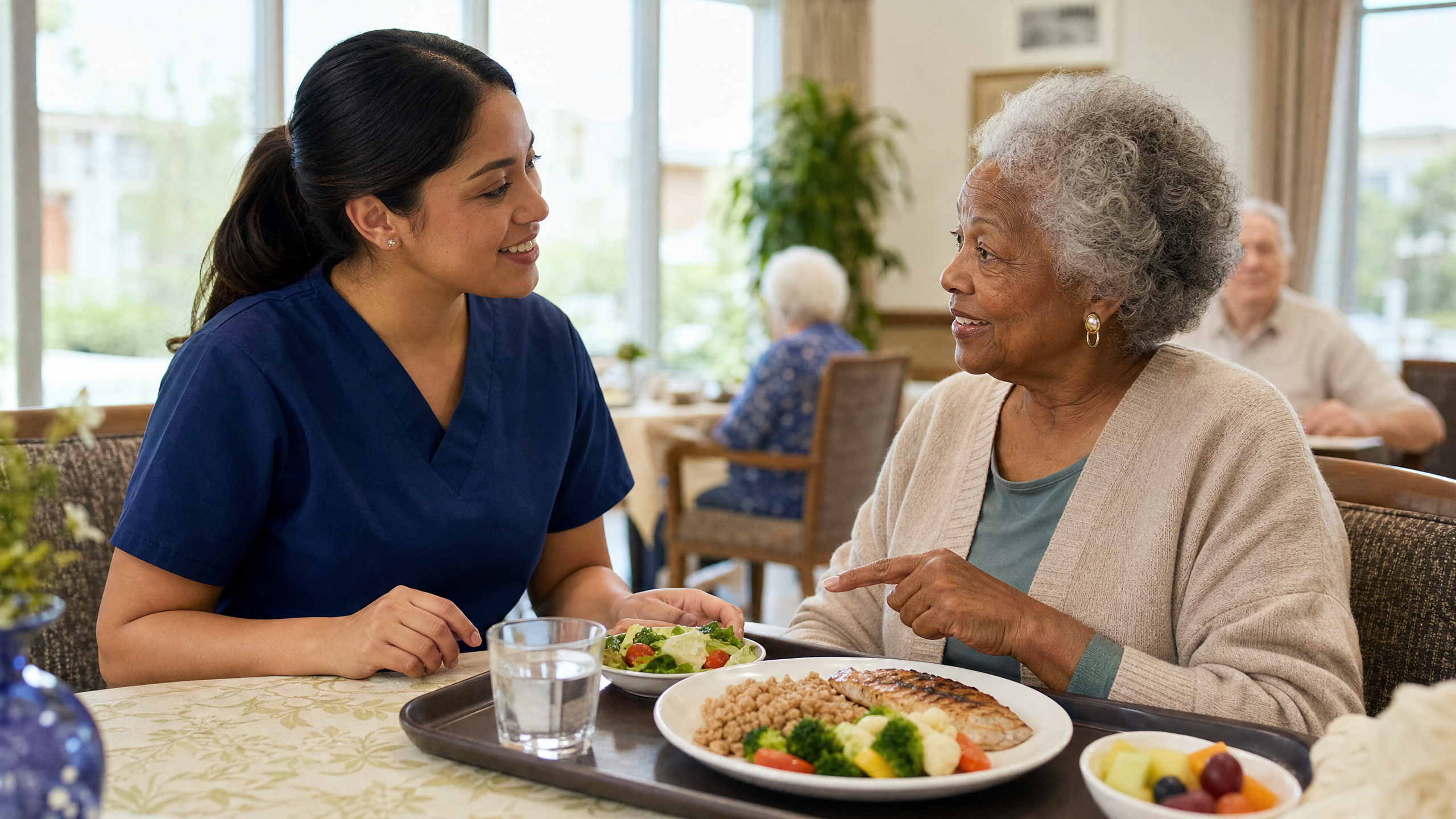
Every meal you serve is part of a resident’s treatment. Food gives the body the energy to get out of bed, the protein to heal a wound, and the vitamins and minerals that keep bones, blood, and the immune system working. For many residents, meals are also the highlight of the day — a time to visit, enjoy familiar flavors, and feel at home.
Older adults are at higher risk of poor nutrition than younger people. Illness, medicines, dental problems, depression, and loss of independence can all reduce how much a person eats. A resident who quietly eats a little less each day can lose weight and strength without anyone noticing — unless the CNA notices. You see residents at every meal. Your observations are often the first warning the care team receives.
Learning Objectives — By the end of this lesson, you will be able to:
- Name the main nutrients and describe what each does for the body.
- Explain why adequate protein, calories, and fluids matter for healing and daily function.
- Identify at least five common reasons older adults eat less.
- Describe the CNA’s role in nutrition within CNA scope.
Key Terms
- Nutrient — a substance in food the body needs to live and grow. The main groups are carbohydrates, proteins, fats, vitamins, minerals, and water.
- Calorie — a unit of energy from food. Too few calories cause weight loss and weakness.
- Protein — the building material for muscle, skin, and the immune system. Protein needs often rise during illness and wound healing.
- Malnutrition — a condition where the body does not get the right amount of energy or nutrients. It can happen in people who are underweight, normal weight, or overweight.
- Dietitian — a nutrition professional who evaluates residents’ nutritional needs and recommends or (when delegated) orders diets.
- Care plan — the written, individualized plan describing each resident’s needs, goals, and interventions, including diet and meal assistance.
What the Main Nutrients Do
| Nutrient | Main job | Common food sources | |—|—|—| | Carbohydrates | Main source of energy for the brain and muscles | Bread, rice, tortillas, pasta, fruit, potatoes | | Protein | Builds and repairs muscle, skin, and tissue; supports immunity | Meat, fish, eggs, beans, dairy, tofu | | Fats | Stored energy; help the body absorb vitamins A, D, E, and K | Oils, butter, nuts, avocado | | Vitamins and minerals | Support bones, blood, nerves, and healing (for example, calcium, vitamin D, iron, zinc) | Fruits, vegetables, dairy, whole grains, meats | | Fiber | Supports regular bowel movements | Whole grains, beans, fruit, vegetables | | Water | Needed for every body function, including temperature control and waste removal | Drinks, soups, and foods with high water content |
Protein and calories work together. If a resident does not eat enough calories, the body breaks down muscle for energy. That leads to weakness, falls, poor healing, and pressure injuries — topics you will see again in Modules 2 and 3 [EVIDENCE — N33].
Why Older Adults Are at Risk
Many changes can reduce appetite or intake in older adults:
- Physical changes: reduced sense of taste and smell, slower digestion, feeling full sooner.
- Mouth problems: missing teeth, loose or lost dentures, mouth sores, dry mouth.
- Swallowing difficulty (dysphagia): common after stroke and in Parkinson’s disease and dementia [EVIDENCE — N12].
- Medical conditions and medicines: many medicines cause nausea, dry mouth, constipation, or a changed sense of taste.
- Cognitive changes: a resident with dementia may forget to eat, not recognize food, or be distracted.
- Emotional and social factors: depression, grief, loneliness, or unfamiliar food.
- Dependence on others: residents who need help eating depend on staff time and patience.
Federal rules require nursing homes to keep residents at acceptable levels of nutritional status, such as body weight, unless the resident’s clinical condition shows this is not possible or the resident makes a different choice [FEDERAL — 42 CFR § 483.25(g); N03]. California regulations require each patient to receive good nutrition and necessary fluids, and assistance with eating when needed [CA LAW — 22 CCR § 72315(g)–(h); N08]. You help the facility meet these requirements every time you serve, assist, observe, and report.
Who Does What on the Nutrition Team
| Team member | Role | |—|—| | Physician or other authorized prescriber | Orders the diet, including therapeutic diets [FEDERAL — N01; CA LAW — N06] | | Registered dietitian | Evaluates nutritional needs and recommends diets; may be delegated diet-ordering where state law allows [FEDERAL — N01] | | Speech-language pathologist (SLP) | Evaluates swallowing and recommends food and drink textures | | Licensed nurse | Assesses residents, monitors weights and intake trends, communicates with the prescriber, updates the care plan | | CNA | Serves the correct diet, assists with eating as care-planned, observes, records intake, and reports concerns | | Resident and family | Share preferences, cultural needs, and goals; may accept or decline food |
Notice what is not in the CNA row: choosing a diet, changing a texture, or deciding a resident "doesn’t need" a supplement. Those decisions belong to the licensed and professional team.
Practice Examples
Example 1 — The quiet decline. Mr. Ramos usually finishes his breakfast. This week he has left most of his eggs and toast three mornings in a row. He says he is "just not hungry." You record his intake accurately each day and tell the nurse: "Mr. Ramos ate about 25% of breakfast on Monday, Tuesday, and today. He says he’s not hungry. That’s not his usual." The nurse checks his weight and contacts the dietitian.
Example 2 — The loose denture. While setting up lunch, you notice Mrs. Pham is chewing only on one side and avoiding meat. She tells you her upper denture "moves." You report this to the nurse so a dental or denture evaluation can be arranged. You do not cut her meat into smaller pieces or switch her to softer food on your own — that would be a texture change, which requires an order.
CNA ACTION — Step by Step
At every meal:
- Know which residents need help and what the care plan says about each.
- Make sure residents are ready to eat: awake, upright, wearing glasses, hearing aids, and dentures if they use them.
- Make food appealing — open containers, season as allowed, keep hot food hot.
- Encourage, but never force, eating.
- Record intake accurately and report changes from the resident’s usual pattern to the licensed nurse.
REMEMBER
Poor nutrition is not a normal or harmless part of aging. Small, steady declines in intake matter. Your daily observations help the care team act early — before a resident loses weight, strength, or skin integrity.
Lesson Summary
Nutrients give residents energy, build and repair tissue, and support healing. Older adults face many barriers to eating well, including mouth and swallowing problems, illness, medicines, dementia, and depression. Diets are ordered and planned by licensed and professional staff. CNAs support nutrition by preparing residents for meals, assisting as care-planned, recording intake, and reporting changes.
Reflection Prompts
- Think of a resident who seemed to eat less over time. What early signs could have alerted the team?
- Why does low protein intake increase the risk of pressure injuries and falls?
- Which members of the care team decide a resident’s diet, and what is the CNA’s part?
References
- [N03] 42 CFR § 483.25(g) — Assisted nutrition and hydration (F692).
- [N01] 42 CFR § 483.60 — Food and nutrition services.
- [N06] 22 CCR § 72335(c); [N08] 22 CCR § 72315(g)–(h).
- [N12] ASHA Practice Portal: Adult Dysphagia.
- [N33] Volkert D, et al. ESPEN guideline on clinical nutrition and hydration in geriatrics (2019).