Course Player
Resident Rights, Abuse Prevention & Mandatory Reporting
Topic
Lesson 1.1 — Course Introduction: Every Resident Deserves Respect
Welcome: Why This Course Matters
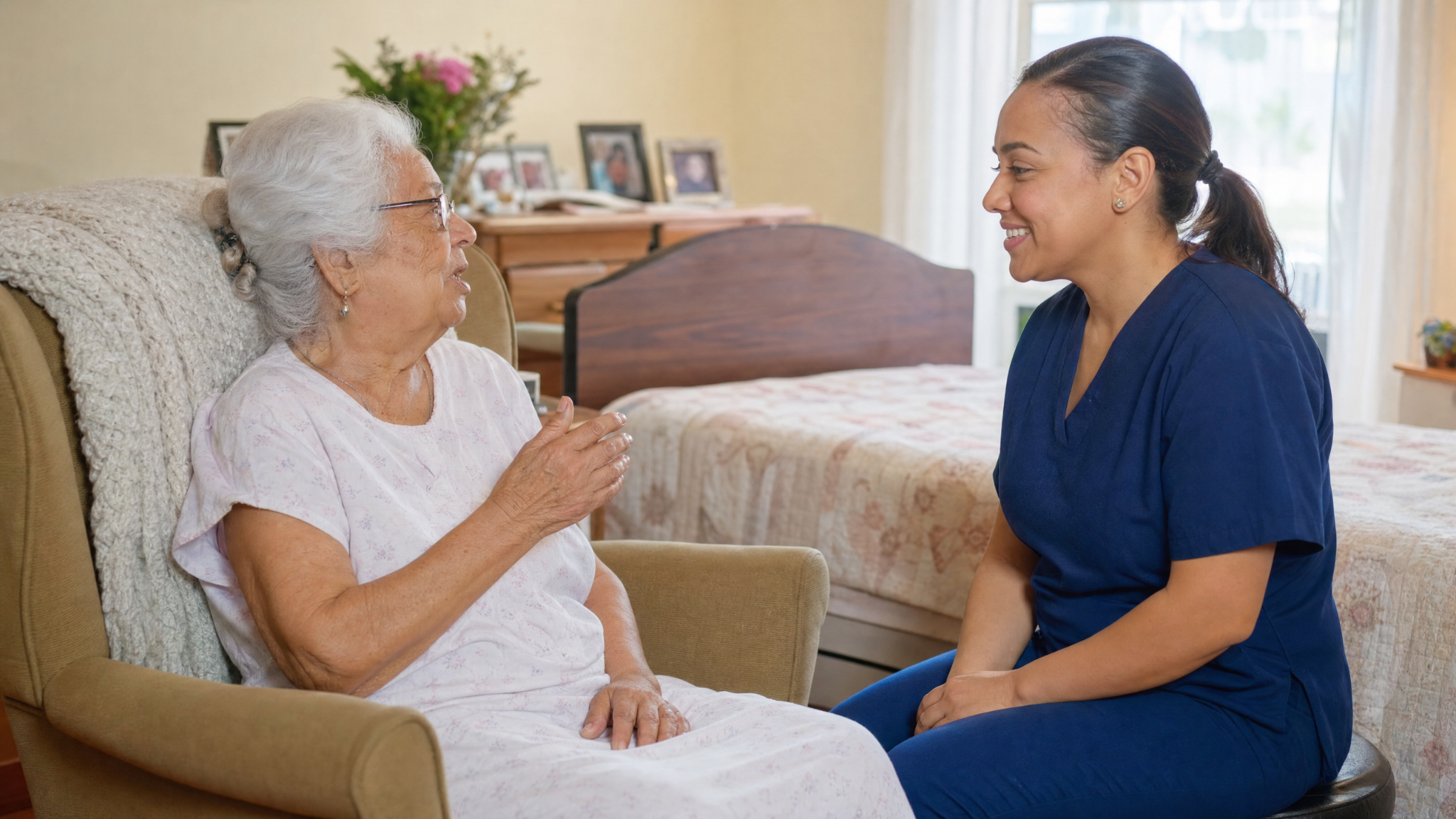
Every day, you walk into the rooms of people who depend on you. You help them get out of bed, eat, bathe, use the toilet, and move safely. Because you are so close to residents, you are often the first person to notice when something is wrong — and the first person a resident trusts enough to tell.
This course is about protecting that trust. You will learn what resident rights are, how to respect them during routine care, how to recognize possible abuse or neglect, and exactly what California and federal law expect you to do when you suspect a problem.
Learning Objectives — By the end of this lesson, you will be able to:
- Describe the purpose of this course and how it connects to daily CNA work.
- Explain the link between dignity and safe care.
- Identify the CNA’s role as an observer, protector, and reporter.
- List the four main topics covered in the course.
Dignity Is Part of Safe Care
Dignity means treating a person as someone who has worth, choices, and feelings — not as a task on a list. Dignity is not "extra." It is part of safe care.
Here is why. A resident who feels ignored or rushed may stop asking for help. A resident who stops asking for help may try to walk to the bathroom alone and fall. A resident who is talked down to may become withdrawn, eat less, and lose weight. Disrespect can lead to physical harm.
The opposite is also true. When residents feel respected, they are more likely to speak up about pain, fear, or mistreatment. Respect opens the door to safety.
Federal rules require nursing facilities to treat each resident with respect and dignity and to care for each resident in a way that promotes their quality of life [FEDERAL — 42 CFR § 483.10(a)(1)]. California regulations for skilled nursing facilities also list patient rights that the facility must protect [CA LAW — 22 CCR § 72527].
Your Role: Observer, Protector, Reporter
As a CNA, you have three key jobs related to resident protection:
- Observer. You notice changes — a new bruise, a resident who suddenly flinches, a call light left unanswered, a missing wedding ring.
- Protector. You make sure the resident is safe right now. That may mean staying with the resident, getting the charge nurse, or calling for help.
- Reporter. You tell the right people what you saw or heard. In California, this includes making reports required by law, not just telling your supervisor.
What you are not asked to do is just as important. You do not diagnose injuries. You do not investigate, interview suspects, or decide whether abuse "really" happened. Licensed nurses, administrators, and outside agencies handle those steps. Your job is to observe carefully, keep the resident safe, and report promptly and accurately.
What This Course Covers
The course has four modules:
- Understanding Resident Rights and Dignity — privacy, choice, culture, refusals, and advocacy.
- Recognizing Abuse, Neglect, and Exploitation — the types of abuse defined in California law and the warning signs of each.
- Mandatory Reporting and Documentation — who must report, when, to whom, and how to document facts.
- Protecting Residents Through Everyday Practice — person-centered care, boundaries, dementia care, de-escalation, and teamwork.
Each module has seven lessons, an interactive activity, a clinical scenario, and a knowledge check. A final exam follows Module 4.
Key terms you will see often:
- Resident — a person who lives in a long-term care facility.
- Mandated reporter — a person whom California law requires to report known or suspected elder or dependent adult abuse [CA LAW — Welf. & Inst. Code § 15630(a)].
- Elder — in California abuse law, a person age 65 or older. Dependent adult includes a person 18–64 with certain limitations, and anyone 18–64 admitted as an inpatient to a 24-hour health facility [CA LAW — Welf. & Inst. Code §§ 15610.27, 15610.23].
Practice Examples
Example 1 — Small choices, big impact. Rosa, a CNA on the day shift, enters a room and says, "Good morning, Mr. Lee. It’s Rosa. Is it okay if I open the curtains?" Mr. Lee smiles and says yes. Rosa has knocked, introduced herself, used his name, and asked permission. These small steps tell Mr. Lee he still controls his own space.
Example 2 — Noticing a change. On Tuesday, Mrs. Patel chatted during her bath. On Thursday, she is silent and keeps her arms folded tightly. The CNA does not ignore it. She gently asks, "You seem quieter today. Is anything bothering you?" She then tells the charge nurse about the change in behavior. The CNA does not guess at the cause. She observes and reports.
CNA ACTION
- Knock, introduce yourself, and use the resident’s preferred name every time.
- Notice changes in mood, behavior, skin, appetite, or belongings.
- Keep the resident safe first. Then report what you observed to the charge nurse.
- Remember that some concerns also require a report to outside agencies under California law (covered in Module 3).
- Stay within your scope: observe, protect, and report. Do not diagnose or investigate.
REMEMBER
Dignity and safety are connected. A resident who feels respected is more likely to ask for help and to tell you when something is wrong.
Lesson Summary
CNAs are often the first to notice problems and the first people residents trust. Federal and California rules require facilities to protect resident dignity and rights. Your role is to observe, protect, and report — not to diagnose or investigate.
Reflection Prompts
- Think of a resident who seemed to trust you. What did you do that helped build that trust?
- How could rushing through care lead to a safety problem?
- In your own words, what is the difference between reporting a concern and investigating it?
References
- 42 CFR § 483.10(a)(1) — Resident rights; dignity and respect. [R16]
- 22 CCR § 72527 — Patients’ rights in skilled nursing facilities. [R12]
- Welf. & Inst. Code §§ 15610.23, 15610.27, 15630(a). [R05, R01]